The Perfect-Memory Myth: Why Retellings Shift
The perfect-memory myth can make family stories feel unreliable. Learn why retellings shift and how to shape a personal story without overstating certainty.
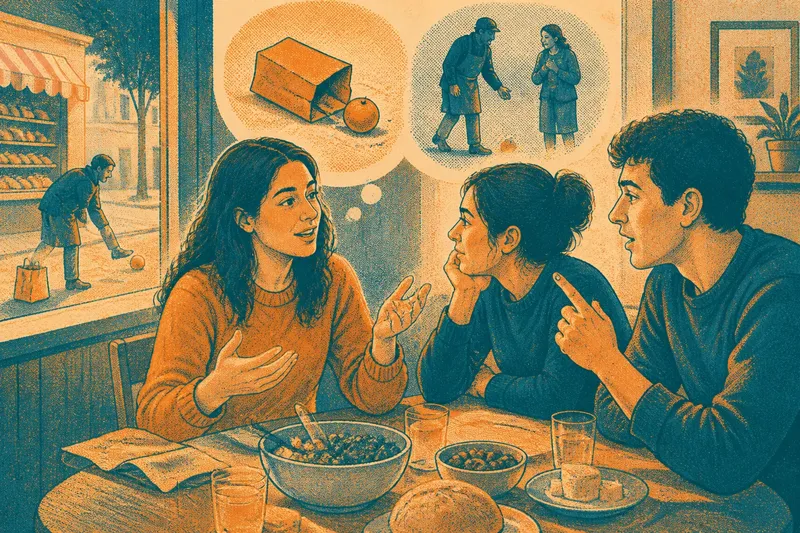
At dinner, Mara tells her cousin about dropping a paper bag outside a neighborhood bakery. A piece of fruit rolled away, and a stranger nudged it back with a shoe. Her brother interrupts: he remembers an apple, not an orange. The scene has changed in the telling, but the moment Mara wants to share is the brief kindness that followed her embarrassment.
The perfect-memory myth treats recollection as a recording that should play back unchanged. Personal stories work differently: attention, emotion, and the reason for telling all influence which details come forward. A shift in a detail does not automatically make a story false. It does invite the teller to notice what is remembered, what is interpreted, and what gives the scene its meaning.
Memory’s moving focus
People do not take in every part of an event with equal attention. Mara may have watched the fruit rolling while barely noticing the stranger’s face. Later, the feeling of being helped may stay clearer than the color of the fruit. When she retells the scene, her attention returns to what mattered to her, not necessarily to every original detail.
Emotion can also influence emphasis. Embarrassment may make the dropped bag feel like the center of the scene; gratitude may make the stranger’s gesture stand out. These are ways of organizing a memory, not proof that the event happened in precisely the order or form the teller now imagines.
Try naming the moment that still feels alive before polishing its details.
Retelling and emphasis
A story changes shape to suit its audience. Mara might tell her cousin a brief version focused on the stranger’s help, then include the family’s disagreement when talking with her brother. The opening, pacing, and ending can shift while the teller remains sincere about what she recalls.
Shaping is different from pretending to know. “The stranger seemed amused” interprets an expression; “I felt embarrassed” describes Mara’s own feeling. If she cannot recall whether the stranger wore an apron, calling the person a bakery employee turns a guess into a claim. A careful storyteller can keep interpretation in the story while making its status clear.
Say Mara’s starting point is a draft that names an orange and describes the stranger as a bakery worker. She rereads it, notices that she remembers neither the fruit’s color clearly nor the stranger’s role, and changes those details to “a piece of fruit” and “someone nearby.” The expected result is a scene that still moves from the dropped bag to the helping gesture, without presenting uncertain specifics as settled.
Perfect-memory myth?
Why do details change in a retelling?
Attention and emotion affect which parts of an event remain prominent, while each telling gives the speaker a reason to select some details over others. A changed detail can reflect ordinary uncertainty or a new emphasis; it does not, by itself, establish intent to deceive.
Can a story change and remain sincere?
Yes. A teller can honestly describe what comes to mind now, even if a detail differs from an earlier version. Sincerity means being candid about the limits of that recollection, not claiming that every telling is identical.
How can I describe an uncertain detail?
Choose wording that matches your confidence: “I remember,” “I think,” or “I’m not sure whether it was an apple or an orange.” If the detail does not affect the scene, use a broader phrase such as “a piece of fruit.”
What matters more than exact wording?
That depends on the story’s purpose and the people it involves. A small uncertainty about fruit may not alter Mara’s account of receiving help, while an uncertain claim about who was present could affect how another person is portrayed.
A drafting checklist
Before sharing a personal story, inspect the language that makes its meaning and certainty clear. For each item, the decision depends on what you can actually recall and what the detail does in the scene.
- Check whether you remember a detail directly or are filling a gap; if you recall it clearly, state it as memory, and if not, mark it uncertain or leave it out.
- Check whether an emotion is yours to report; if you remember feeling embarrassed, describe that feeling, and if you are guessing what another person felt, frame it as interpretation or omit it.
- Check whether a description assigns someone a role, such as employee or relative; if you remember the role, include it, and if you only remember a person nearby, use that broader description.
- Check whether a disputed detail changes the point of the story; if it matters, name the uncertainty, and if it does not, use a neutral phrase that lets the scene continue.
- Check whether the opening gives the reader a clear entry into the event; if it does, keep it, and if it depends on a doubtful detail, begin with a part you remember more confidently.
- Check whether the ending reflects what the moment means to you now; if it does, retain it as your interpretation, and if it claims to explain everyone’s motives, narrow it to your own response.
Meaning without certainty
Mara can tell her cousin that she remembers dropping a bag, watching fruit roll, and feeling relieved when someone helped. She can add that her brother remembers an apple. The unresolved detail remains visible, while the story still carries its central movement from embarrassment to relief.
The perfect-memory myth makes every variation seem like a defect. A more useful approach is to shape the scene around what you can honestly say, using precise language for clear memories and broader language for uncertain ones. That practice leaves room for a story to change in emphasis without pretending that recollection is flawless.
When you revise a memory, keep one question beside the draft: does this sentence describe what I recall, or does it make the scene sound more certain than it is? The answer can guide a small edit that preserves both the story’s feeling and your candor.