A Familiar Street, Seen Again on a Slow Walk
A slow walk along a familiar street can sharpen a story of place by helping you notice its sounds, changing routes, and small, present-day details.
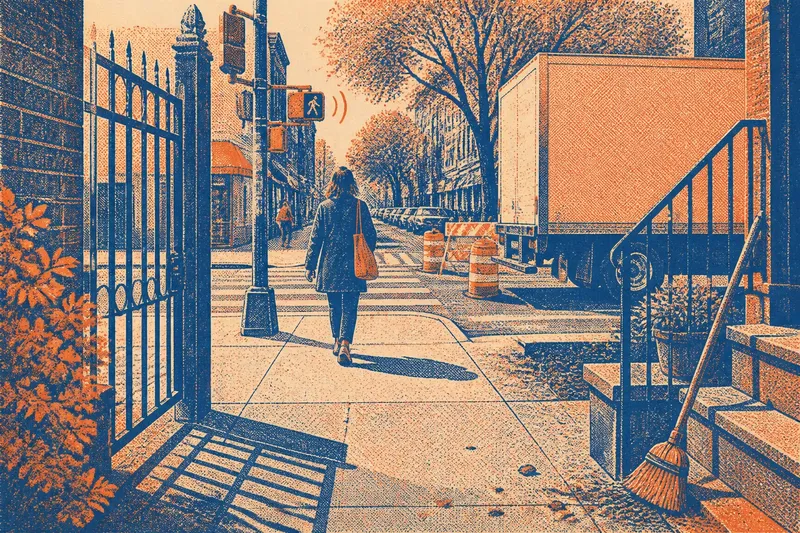
You take the usual turn toward the corner store, but a delivery truck has narrowed the sidewalk, so you cross early. A gate clicks shut behind you; somewhere farther along, a broom brushes grit from a stoop. On a familiar street, even a small change can alter the route and the way the place feels. A slow walk offers a simple way to notice those details without turning the walk into a search through memory.
There is no need to write as you walk or to decide what a detail means. The aim is to attend to the street as it is now: how sound travels, where your feet go, and what has changed in plain view. Afterward, you can choose whether any of those observations belong in a story of place.
Three walking approaches
A slow walk can take several forms. The choice depends on what you want your attention to do, how much time and privacy you have, and whether you are writing afterward. These approaches are not stages in a process. Each gives the street a different kind of attention, and each can stand on its own.
Follow the sound
For a sound-led walk, keep your pace easy and notice the order in which sounds reach you. A bus may announce itself before it appears. Footsteps can grow louder beneath an awning, while a hedge muffles traffic on the next block. Listen for changes in distance, rhythm, and interruption rather than trying to identify every source.
This approach suits someone who tends to hurry along a familiar route without registering its atmosphere. It can also help a writer describe a place without relying on visual details alone. Sound makes a street feel active and occupied, but it does not have to be dramatic. A latch, a crosswalk signal, or a cart rolling over uneven paving may be enough to distinguish one stretch from another.
Give the walk a simple focus: notice where the loudest sound begins and where it fades. Do not follow noise into private spaces or record people without permission. Quiet attention can be more useful than collecting every sound.
Let the route change
On a route-led walk, notice the choices your body makes. Do you avoid a cracked slab, step aside for a stroller, take the sunny side, or turn down a passage you usually ignore? The route is not only the map from one destination to another. It is also a series of small decisions shaped by the street’s current conditions.
This approach suits someone who is curious about how a familiar place guides movement. It can show how a curb, parked car, construction barrier, or open shop door changes the available path. You need not make a deliberate detour; an ordinary adjustment is enough to reveal the street’s pattern.
Keep your attention on the public path and your surroundings. If a route feels uncomfortable or unsafe, choose another. The point is to notice movement, not to prove how far you can wander.
Look for small changes
A change-led walk focuses on what is different from the last time you paid attention. A newly painted door, a removed sign, a tree trimmed back from a window, or a patch of fresh paving can alter the view without transforming the block. Notice both the change and what remains beside it.
This approach suits someone who likes visual detail or wants a grounded description of a place in the present. A change can be especially useful in a story because it gives the reader something observable to hold onto. Still, avoid treating every alteration as a symbol. A new planter may be no more than a planter, and plain description can carry its own interest.
Look at one stretch from more than one position, such as across the road and closer to the building line. Keep a respectful distance from homes and businesses; a story of place does not require looking through windows or naming people.
Choose by attention
To choose among the approaches, ask what you find easiest to overlook. If the street tends to blur into background noise, follow sound. If you arrive at a destination without remembering how you got there, attend to route choices. If the block feels unchanged because you pass it so often, look for small changes.
Imagine you walk the same route to a neighborhood library most afternoons. You notice that a temporary sidewalk barrier makes you cross at the corner, where the crosswalk signal gives a steady chirp. On another day, you may follow the chirp as it blends into traffic, or watch how people adjust their paths around the barrier. The observable details could later anchor a short scene, but the walk itself does not need to become a writing assignment.
You can also combine approaches without forcing a result. Start with the route, then let a sound or visible change interrupt your attention. If the walk becomes a checklist of things to collect, set the list aside and return to an easy pace.
Keep attention comfortable
A familiar street can be busy, private, or unpredictable. Choose a route and pace that let you remain aware of traffic, other pedestrians, and your own comfort. You can pause at a public bench or widen your path around a crowded doorway. There is no benefit in lingering where you feel conspicuous or in blocking someone else’s way.
Try not to turn passersby into characters by guessing at their lives. A person’s coat, voice, or hurried step may be noticed as part of the street’s passing activity, but a story need not assign them an identity or motive. Focus on details you can observe without making another person the subject.
If you want to keep notes, write them after the walk or stop somewhere appropriate. A few plain words—“metal gate clicking,” “shade ends at corner,” “crossed beside the bakery”—can preserve the observation without insisting on its meaning. You can decide later whether it belongs in a piece of writing at all.
Questions about slow walks?
How long should a slow walk take?
Choose a stretch short enough that you can pay attention without rushing to reach a destination. The useful length is the one that leaves room to notice the street while still feeling comfortable.
Should I take notes while walking?
Not necessarily. If writing would distract you from traffic or make the walk feel like an assignment, remember a small phrase and jot it down afterward in a safe place.
What if nothing seems different?
Stay with a basic feature such as the sound under an awning or the path around a parked vehicle. Repetition can be worth noticing too; the point is attention, not discovering a striking change.
Can I use the walk in a story later?
Yes, if a present-day detail helps you describe the place clearly. Keep observation distinct from interpretation, and include only what serves the story rather than everything you noticed.
Carry one detail forward
After the walk, choose one detail that remains clear: a route bending around a barrier, a sound fading behind a row of trees, or fresh paint beside an old sign. Write it in plain language before adding any explanation. A specific detail can help a reader picture the street, while your restraint leaves room for the place to feel ordinary and alive.
The next time you pass through, the street may offer something else to notice. You do not have to make each walk into a story. Letting one small observation stay with you is enough to make a familiar route feel newly present.